Harm Sand

Harm Sand

I'm a product leader who uses AI to modernize how insurers handle claims and pay healthcare providers.

I came to insurance technology after years in retail operations at Apple, and I hold an MBA from UBC Sauder.

Documents arrive, AI groups them and classifies each type, AI reads the text, and the system receives decision-ready fields. AIDocuments arriveAI groupingClassificationAI text readingDecision-ready fields

01About

I take messy operational problems in claims and provider billing and turn them into software people use. I know the insurance side well: how claims move, how providers get paid, and what regulators and auditors expect to see.

I'm interested in how AI changes that work, including getting systems ready for AI agents and software-to-software exchange. I build with AI myself, so I judge what works from using it.

02What I do

AI in regulated operations

Putting AI into production where decisions have to stand up to audit. Intelligent document processing for medical and claims documents, human review designed into the workflow from the start, and the privacy and governance work that lets an insurer trust what the model is doing.

Provider and payer technology

The systems between insurers and the healthcare providers who treat their clients: provider registry and onboarding, invoicing and payment, the rules that decide what is covered and payable, identity and access, and the integrations that connect it all. A growing part of the work is getting these systems ready for AI agents, so software can work directly with other software instead of waiting on people and paperwork.

Claims and case management

Tools for the people who manage claims and cases: intake, triage, case workflow and decision support, built so staff spend their time on judgment rather than paperwork.

03Featured projects

Document intelligence for a workers' compensation insurer

Much of what reaches an insurer still arrives by fax. This product takes incoming documents, whether faxes, scans, images or files, groups and sorts them, identifies each document type, reads the key fields, and formats the results so they go straight into the claims system.

I own the product as part of the portfolio I lead, covering document classification, OCR, the uploader and the format transformer.

It is on track to turn nearly a million faxes a year into fielded information staff can act on, with less manual handling and lower cost.

Fireside: how far one product manager can take real code
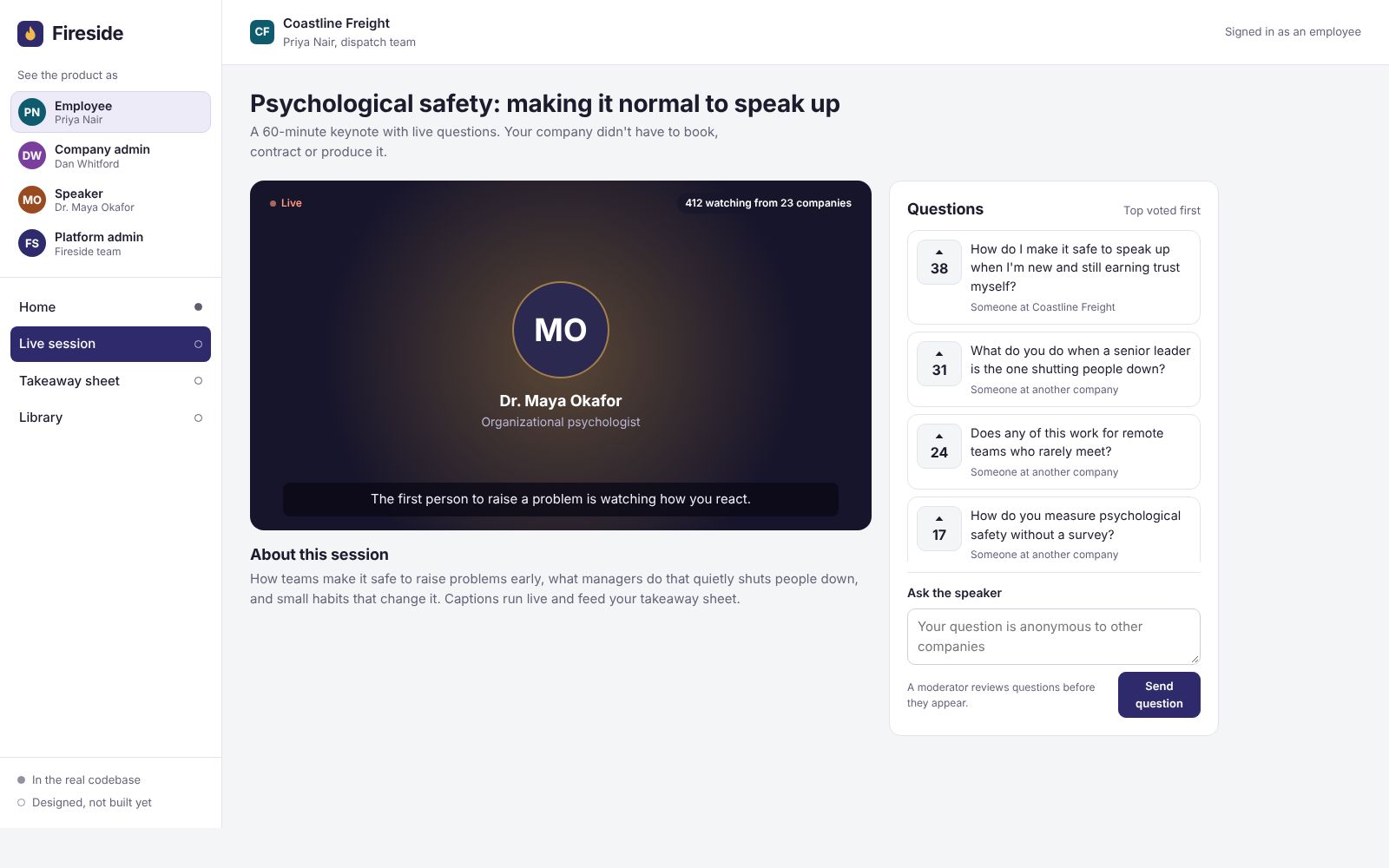
The Fireside live session screen: a speaker on stage with live captions, and audience questions ranked by votes.

Companies pay to book one outside speaker for one talk, then repeat the search, contract and production for the next. Fireside is a subscription where many companies share the same live speakers, with live questions, a takeaway sheet written for each attendee, and attendance reporting for HR.

I built it end to end on my own as an exercise in AI-native development: real code, a real database and a production pipeline, with Claude as architect, engineer, designer and QA, and me making every product call. The work ran on the guardrails I would expect from an engineering team, including row-level security, versioned migrations, commit checks, error monitoring and written decision records.

The foundation is built and tested, company accounts are built, and the rest is designed. The demo shows the full product with made-up data; the case study covers how it was built and what went wrong.

Read the case studyOpen the demo

Baseline: a preventive health dashboard
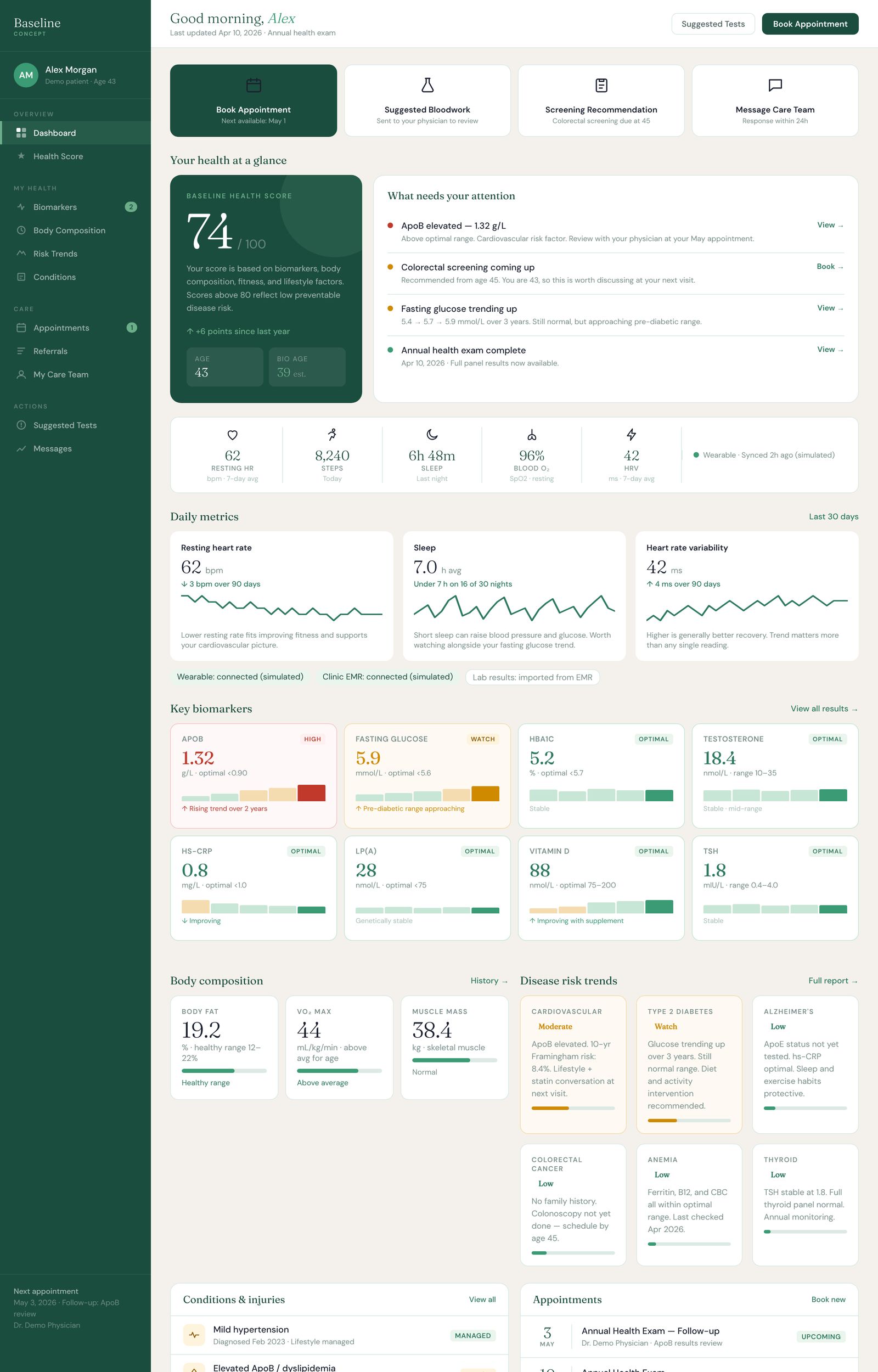
The Baseline dashboard: a health score of 74, the items that need attention, and wearable readings for heart rate, steps, sleep and HRV.

Most people see their health in pieces: lab results as a list of numbers, wearable data in another app, appointments and referrals somewhere else. Baseline is a concept for a patient-facing dashboard that brings it all into one place, so people own their health information and can see the full picture.

I designed and built the clickable prototype to show what modern personal health care could look like. It combines lab results with wearable data on activity, heart rate and sleep, and shows key risks, history, upcoming appointments and suggested next steps. Suggested tests go to the physician for review rather than being ordered, so clinical judgement stays with the clinician.

It is a working prototype with synthetic data and a two-minute guided tour.

Open the prototype

04Background

Now

Senior Manager, Product Management at WorkSafeBC, British Columbia's workers' compensation board. I lead a team of five product managers.

Before

  • Co-founder, Velour, a media company
  • Sales Manager, then Inventory Supervisor, Apple, 2010 to 2016. Inventory lead for the largest Apple store in Western Canada.

Education

MBA, UBC Sauder School of Business

Areas I know

Provider portals, payer-provider integration, identity and access, AI document intelligence, claims management.

Contact

Happy to talk about AI in insurance and healthcare.

Message me on LinkedIn

Some of what I build is on GitHub.